3 min read
An AI with your entire repo will still get the facts wrong
I use AI coding agents heavily, but giving them the whole repository does not make their claims about it reliable.
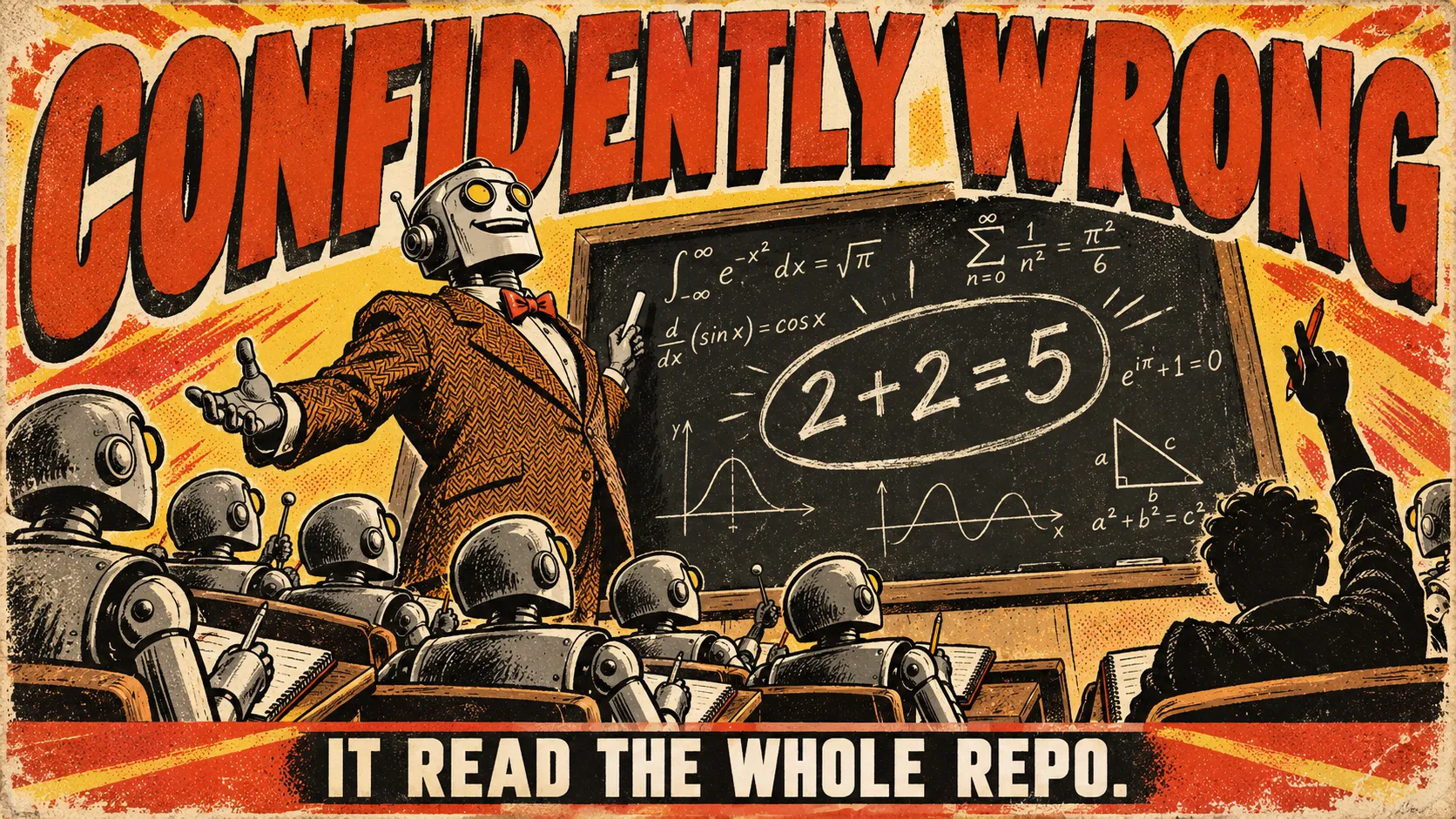
Good code, bad facts
I use AI coding agents heavily at work and on my side projects. They are excellent at code. In the same session, the same agent can write code that compiles and confidently get the facts about the project wrong.
It reads the whole repository. It writes tests and fixes what those tests catch. Then it tells me something about the project's history, its people or its purpose that it has no business stating as fact.
I've spent twenty years shipping software and I run engineering teams. I like tools that can do useful work. These agents do plenty of useful work.
Having the repository gives the agent material to read. It does not make every statement in that material true. A README that has drifted from the code is still sitting there, ready to be repeated with full confidence.
The agent also fills gaps with plausible things. In what I've seen, it never says, "I don't know this."
Code has somewhere to fail
Code gives the machine ways to check its work. A wrong line can fail a test, a type check or a build. The agent gets a failure it can work on, changes the code and checks again.
A sentence about what the product does, who built it or why has no equivalent check. It can be wrong and still pass through the entire workflow without causing anything to fail. It just sits there looking right, with the same confident tone as the explanation of the code that compiled. The tone tells me nothing about the evidence behind the claim.
Reading more files doesn't settle the problem if they disagree or the history isn't there. I can use the code to check what the code does. I cannot use a successful build to check who built the product or why they made a decision. Those claims need their own evidence.
Facts in, prose out
My rule is facts in, prose out. I give the agent the facts and let it write. It can do the work of putting sentences together without taking on the job of deciding what happened.
Anything it adds is wrong until proven.
That is how I treat additions, even when they sound reasonable. Plausibility is what makes them easy to miss. A claim that fits neatly into the paragraph still needs a source.
If a sentence contains a number, a name, a date or a claim about the past, I find where it came from. If I didn't supply it, I need to establish it before I keep it. Good prose doesn't get an exemption.
Read every claim
The workflow works because a human reads every claim that isn't covered by a test. That reading is part of the work, and an agent producing a finished paragraph hasn't finished checking it. I still use the agents heavily for prose and code. I keep responsibility for the facts because nothing in a passing build takes that responsibility away.
When I read an agent's output, I have to check what each factual sentence rests on. If I can't find where a claim came from, I don't get to keep it just because I like how it sounds. You are the fact-checker, always.